
US-Iran Peace Deal Nears Signing as Trump Announces Sunday Agreement
US-Iran Peace Deal
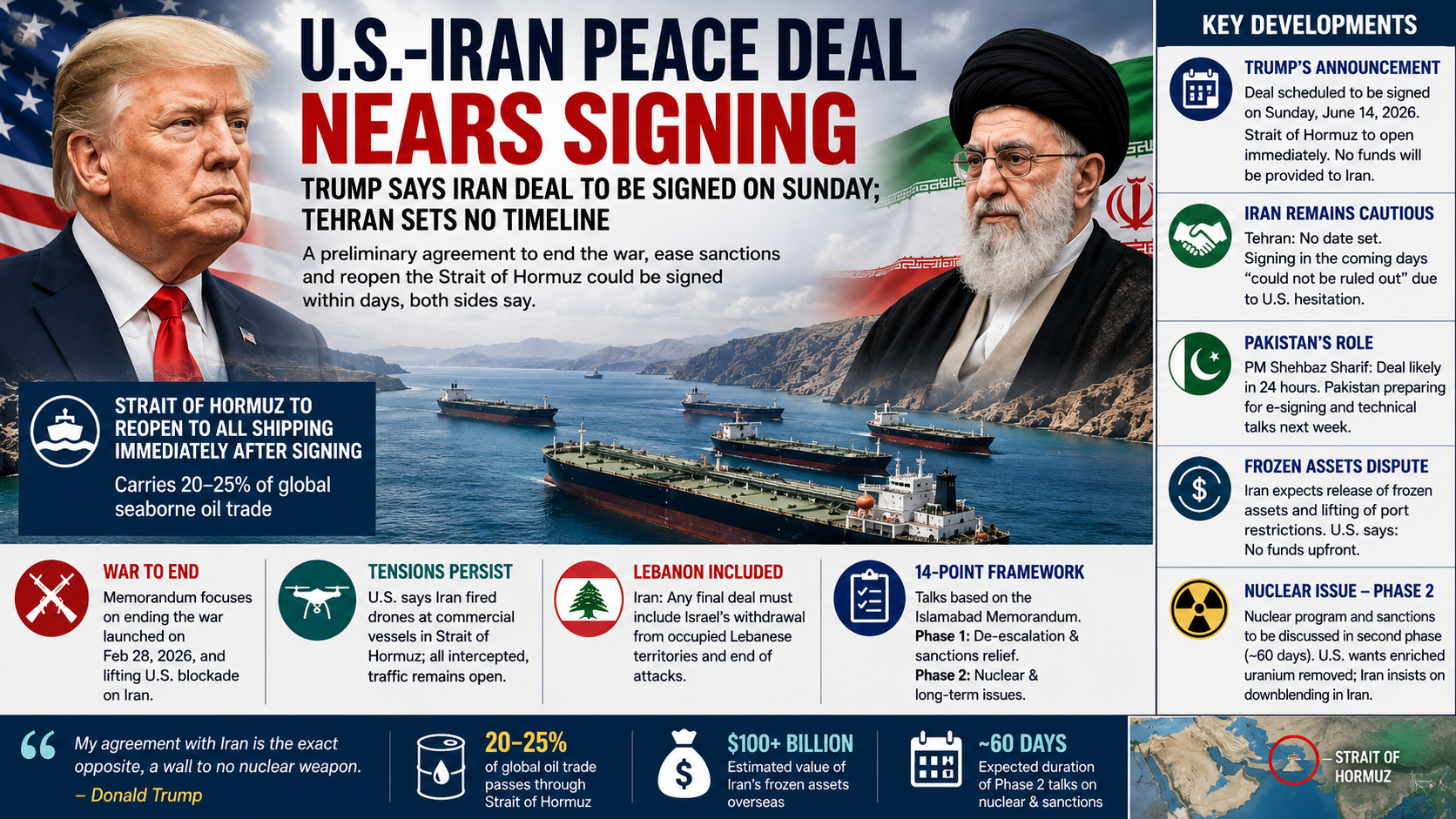
US-Iran Peace Deal negotiations moved closer to completion on June 14, 2026, after U.S. President Donald Trump announced that a preliminary agreement could be signed within days. The US-Iran Peace Deal is expected to reopen the Strait of Hormuz, reduce regional tensions, and begin a new phase of diplomatic discussions between Washington and Tehran.
Analysts say the US-Iran Peace Deal could have major implications for global energy markets. The second phase of the US-Iran Peace Deal will focus on Iran’s nuclear programme, sanctions relief, and regional security arrangements. If successful, the US-Iran Peace Deal could become one of the most significant diplomatic breakthroughs in the Middle East in recent years.
A preliminary peace agreement between the United States and Iran could be signed within days, with U.S. President Donald Trump claiming that the accord is scheduled for Sunday, while Iranian officials continue to avoid committing to a specific timeline.
The proposed agreement, reportedly based on a 14-point framework known as the Islamabad Memorandum, is aimed at ending the conflict that began on February 28, 2026, easing economic restrictions on Iran, and restoring stability to one of the world’s most critical energy corridors—the Strait of Hormuz.
Key Developments
Trump Announces Expected Signing
In a social media statement on Saturday, President Trump declared that the agreement would be signed on June 14 and that the Strait of Hormuz would immediately reopen to all international shipping.
“The deal is scheduled to get signed tomorrow, and immediately after it is signed, the Hormuz Strait is open to all.”
The President described the agreement as a stronger non-proliferation framework than the 2015 nuclear deal negotiated under former President Barack Obama, arguing that it would permanently prevent Iran from acquiring nuclear weapons.
Iran Remains Cautious
Iranian Foreign Ministry spokesperson Esmaeil Baqaei confirmed that negotiations are in their final stage but emphasized that no signing date has been officially established.
According to Tehran, while a signing in the coming days remains possible, unresolved issues and what Iran describes as American “hesitation” continue to delay final approval.
Pakistan’s Diplomatic Role
Pakistan has emerged as a significant mediator in the negotiations. Prime Minister Shehbaz Sharif stated that a peace agreement was likely within 24 hours and that Pakistan was preparing for electronic signing procedures followed by technical-level negotiations next week.
Diplomatic observers note that Islamabad’s role has expanded considerably during the conflict, positioning Pakistan as a key regional intermediary between Washington and Tehran.
Economic Stakes
Strait of Hormuz
The Strait of Hormuz carries approximately 20–25% of global seaborne oil trade, making it one of the most strategically important maritime chokepoints in the world.
Key implications of reopening include:
- Reduced energy market volatility
- Lower shipping insurance premiums
- Stabilization of global crude oil prices
- Improved supply-chain reliability across Asia and Europe
Iran had announced the closure of the strait after military exchanges with US-Iran Peace Deal forces earlier in the week.
Frozen Iranian Assets
A major point of disagreement concerns Iran’s frozen overseas assets.
Iranian Foreign Minister Abbas Araghchi stated that the agreement would lead to the release of blocked funds and easing of port restrictions. However, U.S. officials have rejected suggestions that immediate cash transfers will occur.
Vice President J.D. Vance clarified that any economic benefits would depend on Iran fulfilling its commitments under the agreement.
Nuclear Issues Deferred to Second Phase
One of the most significant revelations is that Iran’s nuclear program may not be fully addressed in the initial agreement.
According to Iranian officials:
- Phase One focuses on ending hostilities and easing economic restrictions.
- Phase Two, expected to last approximately 60 days, will address nuclear issues and long-term sanctions relief.
A major sticking point remains Iran’s stockpile of highly enriched uranium.
Trump indicated that the United States intends to secure and neutralize the material, either inside Iran or by transporting it elsewhere for downblending and disposal.
Iran, however, insists that any downblending process must occur within its own territory.
Security Concerns Continue
Despite progress in negotiations, tensions remain high.
The U.S. Central Command reported that Iranian drones targeted commercial vessels in the Strait of Hormuz on Friday night. American forces claimed to have intercepted all incoming drones, preventing disruption to maritime traffic.
The incident highlights the fragile security environment even as diplomats move toward a ceasefire framework.
Regional Dimension
Iran has also linked the broader agreement to developments in Lebanon.
Foreign Minister Araghchi stated that a lasting settlement must include Israeli withdrawal from occupied Lebanese territories and a definitive end to military operations there.
Analysts suggest that the final agreement may evolve beyond a bilateral US-Iran Peace Deal arrangement into a wider regional security framework covering multiple conflict zones across West Asia.
Outlook : US-Iran Peace Deal
While both Washington and Tehran now acknowledge that negotiations are nearing completion, significant differences remain regarding sanctions relief, nuclear material management, and regional security guarantees.
If signed, the agreement would represent the most substantial diplomatic breakthrough between the two countries in more than a decade and could reshape geopolitical dynamics across the Middle East, global energy markets, and international nuclear non-proliferation efforts.
Read More About : Us Iran Air Strikes
Resource Link: THE HINDU